
Whether you’re someone who openly admits you’d like more confidence, this article is for you.
And if you’re someone who is currently thinking, “I don’t need help with my confidence,” this article is probably even more for you.
Because one of the biggest challenges with confidence is that it’s often mislabelled – what people describe as a confidence problem is often something else entirely.
And that’s where things start to get interesting.
A few years ago, a friend of mine said something that stopped me in my tracks.
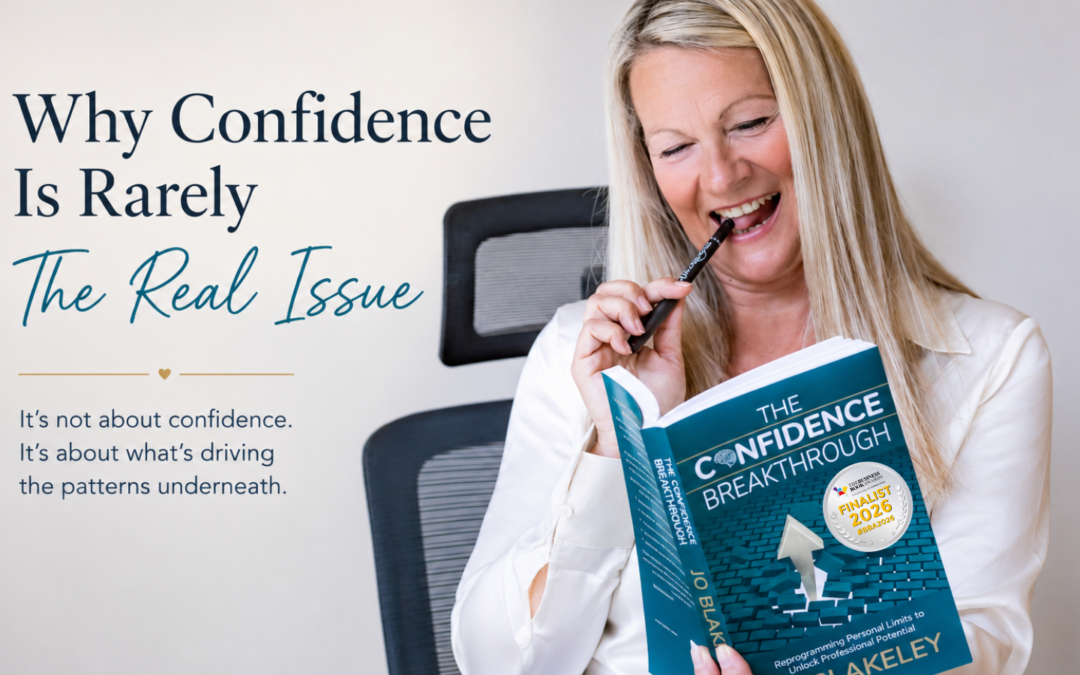
At the time, I was talking about writing a book about confidence (which eventually became The Confidence Breakthrough™).
She listened – politely – for a while before saying: “I don’t know why you’re telling me about this. I don’t have a confidence problem.”
I smiled – politely – because she was wrong. Very wrong. I had just seen it with my own eyes.
Now, before you think I’m being rude, or judgemental, let me explain.
This particular friend had been hugely successful in her career. She was intelligent, capable, accomplished and nobody would ever have described her as lacking confidence.
In fact, if you’d met her professionally, you would have assumed she could handle just about anything. And you certainly wouldn’t have wanted to get in her way.
But earlier that day, I’d watched something interesting happen.
Her five-year-old’s teacher had spoken to her in a way she felt was rude and disrespectful. On the thirty-minute walk home, she spent the entire time telling me how annoyed she was.
- “She can’t speak to me like that.”
- “Who does she think she is?”
- “She’s so rude.”
The more she talked, the angrier she became.
Eventually, I asked the obvious question: “So what are you going to do about it?”
“Nothing,” she replied.
“Why not?”
“Because I don’t want to upset her.”
I remember stopping and looking at her.
“What would you have done if someone had spoken to you like that at work?”
Without hesitation, she replied:
“I’d have shot them down until they felt an inch tall.”
“So you don’t mind upsetting people at work, but you do mind upsetting people in your personal life?”
“Exactly.”
I’m her friend, not her coach so I left it there.
But the conversation stayed with me because my friend was convinced she didn’t have a confidence problem.
And in one sense, she was absolutely right – she wasn’t lacking confidence everywhere – but she was struggling somewhere.
And that’s the bit many people miss.
Confidence Is Rarely All Or Nothing
One of the biggest misconceptions people have about confidence is that it’s either present or absent.
You’re either confident or you’re not. End of story.
But human beings don’t work like that. Most of us are perfectly comfortable in some situations and completely different in others.
- You might be able to stand in front of a room full of people and deliver a presentation without breaking a sweat, yet find yourself replaying the feedback you got from the talk for three days afterwards.
- You might confidently manage a team of twenty people but struggle to ask for help.
- You might happily challenge a colleague but avoid setting a boundary with a friend.
- You might be confident in your professional life but hold yourself back everywhere else.
Or vice versa.
Which is why confidence isn’t really the thing I’m interested in, it’s the patterns underneath it.
The Hidden Patterns We Don’t See
Over the last few weeks, I’ve written a lot about hidden patterns.
- The People Pleaser.
- The Imposter.
- The Overthinker.
- The Avoider.
And one of the things I’ve noticed is how quickly people recognise themselves. Almost every week somebody messages me to say:
- “I think you’ve just described me,” or
- “I didn’t realise there was a name for what I do,” or
- “I genuinely thought that was just my personality.”
Recognition is powerful, but recognising a pattern and changing a pattern are two very different things. Because patterns don’t appear out of nowhere – something creates them. Something drives them.
And that’s where things get interesting.
The Pattern Wasn’t The Problem
Looking back, I can see this in my own life too.
If you’ve read some of my previous articles, you’ll know that I was successful at school, university and in my early career: I did well academically, I did well in sales, I was promoted and I received positive feedback.
Everything seemed to be going in the right direction.
What I didn’t realise at the time was that all my teachers and bosses had been female.
Then I got my first male boss and suddenly everything changed. For the first time in my life, I felt held back, I didn’t feel listened to, I didn’t feel valued and I didn’t feel respected. I became increasingly frustrated, confused and unhappy.
At the time, I thought the problem was him.
Looking back, I now know there was something much deeper happening: a programme I’d carried for years had quietly come online.
Until then, it had remained largely hidden. Dormant. Invisible.
Then the right situation triggered it and once it was active, it began influencing how I thought, reacted and behaved.
It affected opportunities I pursued, conversations I had, conversations I avoided and how visible I made myself.
The pattern was visible – the programme wasn’t. At least not initially.
Breakthrough Insight
Most people spend years trying to change the pattern without ever understanding what’s creating it so they try to become more confident, more assertive, more resilient and more courageous.
And whilst those things can absolutely help, lasting change becomes much easier when you understand what’s driving the pattern in the first place.
Because when that changes, the pattern often changes too.
It’s Never Really Been About Confidence
Ironically, this brings me back to my friend’s comment.
“I don’t have a confidence problem.”
The older I get, the more I think she was partly right.
In fact, over the years I’ve sometimes wondered whether I’ve accidentally created confusion by calling my book The Confidence Breakthrough™.
The truth is, confidence was never the easiest label for what I do.
When I was writing the book, I spent an embarrassingly long time – we’re talking two years – trying to decide what to call it.
At one point, I seriously considered calling it There Is No Spoon.
If you’ve seen The Matrix, you’ll know exactly what I mean. If you haven’t, that sentence probably sounds mildly concerning.
Unfortunately, after spending twenty minutes trying to explain the title to somebody who hadn’t seen the film, I realised it probably wasn’t the strongest marketing strategy I’d ever come up with.
So I abandoned that idea and eventually, I landed on confidence.
Not because confidence is the whole story, but because it’s something people instantly recognise. Most people understand what confidence feels like, or more accurately, what it feels like when it’s missing.
The challenge is that confidence is often the visible outcome rather than the underlying issue, which is why I’ve increasingly realised that most people don’t actually have a confidence problem. Not really.
What they have is a pattern that’s holding them back somewhere in their life.
- Sometimes it’s obvious.
- Sometimes it’s hidden.
- Sometimes it’s been there for years.
- Sometimes it only appears in very specific situations.
But almost all of us have something.
And when people begin to understand the patterns holding them back, and the things driving those patterns, something remarkable often happens.
They naturally become more confident. Not because confidence was the goal, but because they understand themselves differently. They stop fighting symptoms and start addressing causes.
As a result, they often become more assertive, they set healthier boundaries, they develop more resilience and they show greater courage.
Not because they set out to learn those things specifically, but because they’re no longer being held back in the same way.
Something Exciting Is Coming
Over the last few months, I’ve been helping people recognise hidden patterns.
- The People Pleaser.
- The Imposter.
- The Overthinker.
- The Avoider.
But recognition is only the first step. Simply knowing a pattern exists doesn’t automatically change it.
Next week, I’ll be sharing something I’ve never offered before. Something designed to help people move beyond recognising their patterns and begin creating meaningful change.
For now, I’ll leave that thought with you.
You Might Also Find These Helpful
If this article resonated with you, you may also enjoy:
- Why Recognising You’re A People Pleaser Is Only The Beginning
- Why People Pleasing Is Not About Being Nice
- Imposter Syndrome at Work: Why You Feel Like a Fraud (Even When You’re Doing Well)
- Why Confidence Isn’t What You Think It Is
Each explores a different hidden pattern shaping how we think, react and behave at work.
Stay Connected
If you’d like more insights like this, you can subscribe to Jo’s Weekly Breakthrough.
Every week, I share stories, observations and Breakthrough Insights that help individuals, teams and leaders understand the hidden patterns shaping confidence, communication, leadership and performance.
Because sometimes the breakthrough isn’t learning something new, it’s finally understanding something that’s been there all along.