
Do you ever wonder if confidence would solve all your problems? That’s certainly what many people think. If only I was more confident, I’d stop:
- hiding and speak up in meetings without going bright red.
- putting everyone else’s needs ahead of my own and say no when necessary.
- replaying conversations in my head weeks after they happened and finally stop
overthinking everything.
- limiting myself and put myself forward for opportunities.
- worrying so much about what other people think of me.
The reason I know this is because, for many years, I thought exactly the same thing. I believed confidence was the thing. If I could just become more confident, everything else would fall into place.
But after learning how to overcome my own confidence challenges, and after spending more than twenty years helping thousands of professionals do the same, I’ve come to a rather surprising conclusion.
Confidence often isn’t the problem.
It’s the outcome.
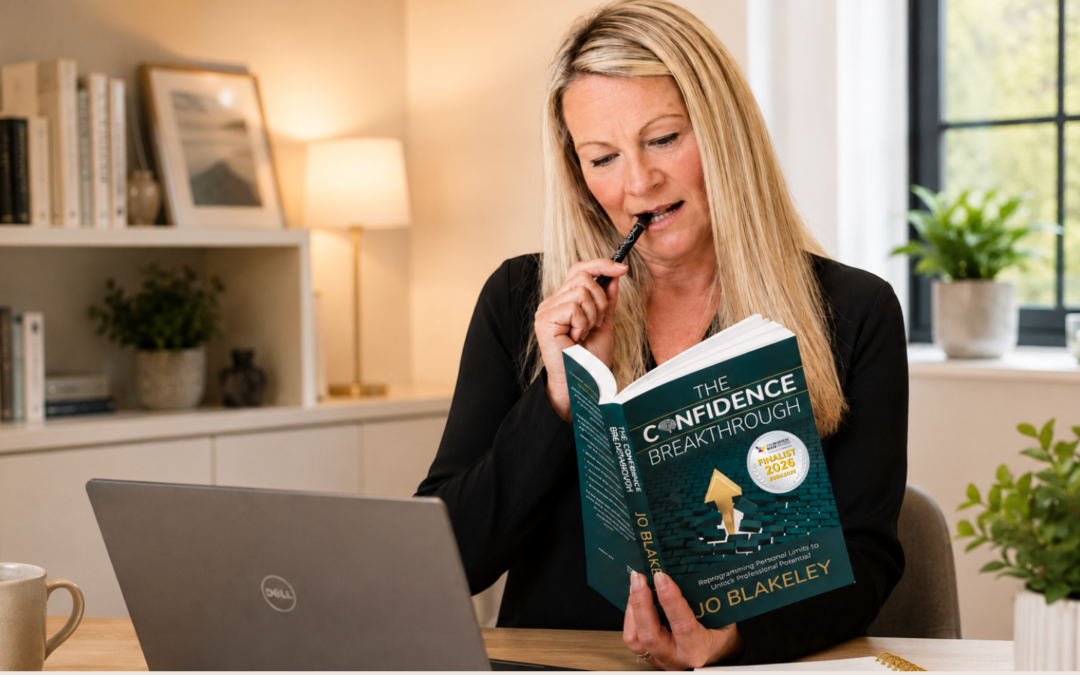
Now, for someone who has just launched a new programme and book called The Confidence Breakthrough™, you might think that’s a slightly strange thing to say.
So let me explain.
The Problem With Confidence
One of the reasons confidence is such a popular topic is because it’s an easy label.
In fact, I’d probably be a millionaire if someone gave me a pound every time a manager sent somebody on one of my courses with the words:
“They just need more confidence.”
And sometimes they’re right, but confidence is rarely the whole story because confidence isn’t a single thing – people lack confidence for lots of different reasons.
- Some people struggle with self-doubt.
- Some experience Imposter Syndrome.
- Some overthink everything.
- Some worry about getting things wrong.
- Some find it difficult to say no.
- Some avoid difficult conversations.
On the surface, these all look like confidence problems.
But are they?
Over the last few months, I’ve written extensively about Hidden Patterns.
- The People Pleaser.
- The Imposter.
- The Overthinker.
- The Avoider.
Many people have recognised themselves immediately, others have recognised colleagues, managers, partners and friends and that’s important because recognition is often the first step towards change.
But if you’ve been following the series, you may also have noticed something: these patterns look very different on the surface yet they often create remarkably similar outcomes.
- Self-doubt.
- Stress
- Frustation
- Hesitation
- Missed opportunities.
Which raises an interesting question: what if the pattern isn’t actually the thing creating the problem? What if something deeper is creating the pattern?
What Sits Beneath The Pattern?
This is where things get interesting because the more I explored confidence, the more I realised that what fascinated me wasn’t confidence itself – it was understanding why people think, feel and behave the way they do.
- Why some people doubt themselves despite being incredibly capable.
- Why some people overthink every decision.
- Why some people feel like frauds despite years of evidence to the contrary.
- Why some people continue repeating the same patterns even when they know those patterns are holding them back.
The answer, at least in my experience, lies in programmes.
Programmes are the unconscious instructions, assumptions and rules that help our brains make sense of the world. They shape how we interpret situations, what we notice, what we expect and ultimately what we experience as reality.
Some are incredibly useful, while others quietly work against us.
The challenge is that most of us aren’t aware they’re there – we simply experience the patterns they create, which is why recognising a pattern and changing a pattern are often two very different things.
My Biggest Challenge
One of the biggest challenges I faced when creating The Confidence Breakthrough™ wasn’t developing the content.
It was deciding what to call it.
Because if I’m being completely honest, it’s never been about confidence itself.
What fascinates me is why people think, feel and behave the way they do.
Take a successful friend of mine who recently told me she didn’t need my book because she didn’t have a confidence problem.
On one level, I agreed with her. She doesn’t lack confidence at work – she’s successful, capable and highly respected. Yet when an infant school teacher spoke to her in a way she felt was unfair and dismissive, she said nothing.
Instead, she spent days replaying the conversation in her head and talking about it to anyone who would listen. Anyone, that is, except the teacher.
Now, was that a confidence problem? A communication problem? A people-pleasing problem? An avoidance problem? Or was it something deeper driving all of those things?
That’s what interests me.
Not the label.
The thing creating the label.
The Telecom Engineers
A few years ago, I was asked to deliver my course to around one hundred telecoms engineers. At the time, I was still experimenting with names for it.
This time I called it Self-Management. In reality, it was still my confidence course, but I didn’t want to call it that because, as far as they were concerned, they didn’t have confidence problems.
And to be fair, they were right. At least not in the way they imagined.
- They weren’t afraid to speak up.
- They weren’t lacking technical expertise.
- They weren’t hiding from presentations.
But they were human, which meant they still had habits, automatic reactions and ways of thinking that sometimes helped them and sometimes got in their way.
Why I Nearly Called My Book “There Is No Spoon”
For a while, I became quite attached to the idea of calling the book and course There Is No Spoon. Partly because The Matrix is one of my favourite films and partly because it captured what I was really trying to teach.
Not confidence.
The mind.
Of course, every time I mentioned the title, I then had to spend twenty minutes explaining it, which is generally a sign you’ve chosen the wrong title.
So eventually I settled on confidence. Not because confidence was the whole story, but because confidence was the thing people were actively looking for.
Confidence became the doorway.
What sat behind the doorway was always something much bigger.
Breakthrough Insight
For many years, I tried to call my course (and book) something different and exciting that explained what it is I teach. But nothing really seemed to explain it well enough.
So I decided that because confidence is one of the key outcomes, this is what I should focus on.
But of course, now you know that what sits behind the doorway is something much bigger, richer and far more transformational.
Which is why The Confidence Breakthrough™ isn’t really a confidence course in the traditional sense.
It’s a programme about understanding how your brain works, why certain patterns keep showing up and how to change programmes that are no longer serving you.
Confidence is simply one of the outcomes, not the starting point. True confidence from the inside out often emerges when we understand ourselves better.
- When we understand why we think the way we do.
- Why we react the way we do.
- Why we continue repeating patterns that no longer serve us.
- And why awareness alone doesn’t always create change.
Ready To Go Beyond Confidence?
And that’s precisely why I created The Confidence Breakthrough™ Live.
The programme is based on ideas, tools and techniques I’ve spent more than twenty years delivering, refining and developing within organisations.
Until now, access to this work has depended on working for an organisation willing to bring me in to deliver it.
For the first time, I’m opening it up to individuals, self-employed professionals and smaller organisations who want access to the same learning and development experience.
Over six live virtual sessions, we’ll explore the questions that sit underneath confidence.
The first cohort begins on 22 September 2026 and runs every Tuesday at 10am.
Because it’s delivered live by me, places are limited to just ten participants to ensure a highly personalised experience.
The investment for this founding cohort is £499. Future cohorts will be priced at £599.
If you’ve recognised yourself in the Hidden Patterns series and would like to understand what might be driving those patterns, I’d love to invite you to register your details.
There is no obligation and you’ll simply receive further information about the programme and how to apply.
So, if you’ve decided you need help with your confidence, this programme is for you.
And if you’ve decided you don’t have a confidence problem at all, but you’re human and have a brain that occasionally does things you’d rather it didn’t, then it’s probably for you too.
You Might Also Find These Helpful
- Why Do We Become People Pleasers, Imposters, Overthinkers and Avoiders
- Why Recognising You’re A People Pleaser Is Only The Beginning
- Why hidden Patterns Are So Much Easier To Spot In Other People
Join Jo’s Weekly Breakthrough
If you’ve enjoyed this article, you might also enjoy Jo’s Weekly Breakthrough — my weekly newsletter exploring the hidden patterns shaping how we think, react and behave at work.
Each week I share personal stories, practical insights and breakthrough moments designed to help you better understand yourself, your colleagues and the person within the professional.