
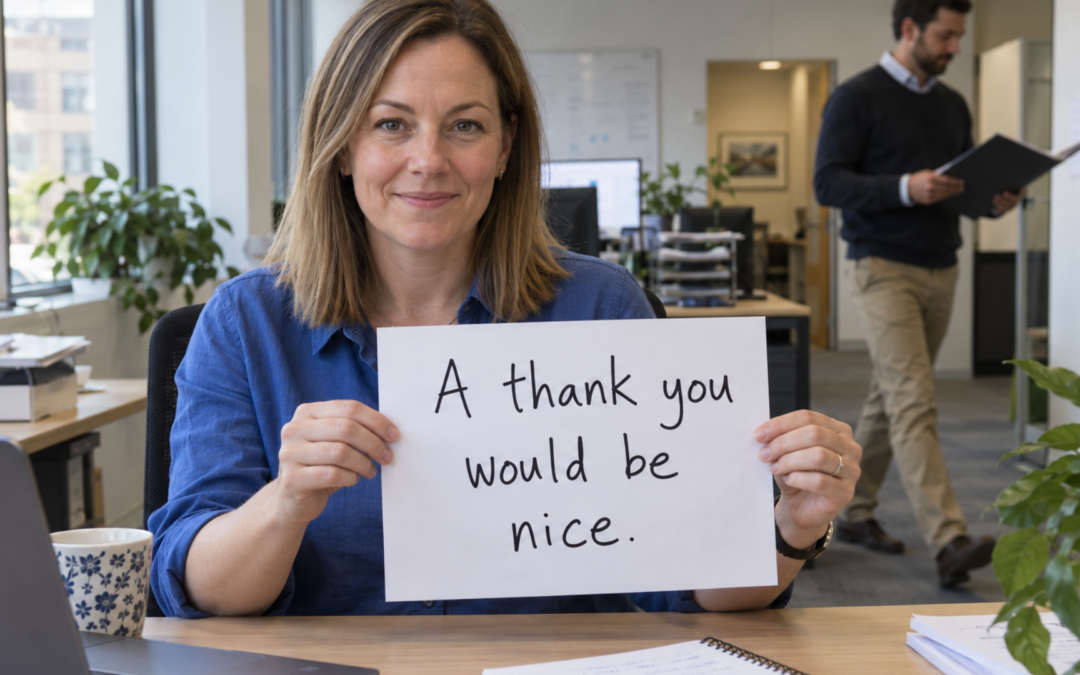
Do you ever feel overlooked and underappreciated? You’ve put time and effort into something, quietly sorted out a problem or kept everything ticking along, and it would be nice to hear a “thank you” from someone. Anyone. You’re not expecting a round of applause or a party thrown in your honour, but a little acknowledgement would help you feel noticed and valued.
And when it’s not forthcoming, you wonder whether you should point out what you’ve done. But somehow, having to ask feels even more annoying than not receiving the appreciation in the first place. Surely they should notice, and you shouldn’t have to!
Two separate clients have said almost exactly the same thing to me: “I want my boss to appreciate me, and I shouldn’t have to ask.” They weren’t looking for constant praise; they wanted their boss to recognise how much they contributed without having to make a case for it themselves.
I understood what they meant, but a few days later, I really understood it.
Last week, I felt thoroughly rotten with a cold. Being self-employed, with a packed week of work already booked, I had little choice but to carry on working while relying on my husband to pick up more of my usual jobs around the house: feeding and walking the dog, keeping on top of the washing, emptying the bins and replenishing the toilet rolls, toothpaste, soap and so on.
I appreciate that none of these things are particularly remarkable when they’re done, but they become considerably more noticeable when they aren’t done – or not done quite as intended. Particularly when you discover that your already “chunky” Labrador is being given twice as much food as she should, your son’s sports kit hasn’t been washed, you’ve run out of shower gel and the soap you’d normally fall back on hasn’t been replenished either. So, after just three days, I might add, we’re heading towards a super-chunky Labrador and a super-smelly 14-year-old.
I wondered whether the things I normally do being left undone – or not quite going to plan – and the resulting fallout might prompt him to notice how much I usually take care of. I hadn’t actually told him I was hoping for appreciation, of course. I was rather hoping he would know without me saying anything.
However, while I was noticing what he might now be noticing about my contribution, I realised how much I rely on his, especially everything he does for our son. I’m so used to him doing those things that I don’t always stop to consider what they involve, or what my day would look like without them. Which was slightly inconvenient for the part of me preparing a persuasive case about being taken for granted.
Apparently, I had some appreciating to do too.
So I told him, and because I work in learning and development, I couldn’t leave it at “Thanks for everything.” I explained specifically what I appreciated, and he looked very pleased that I’d noticed and taken the time to tell him.
Then there was an awkward silence while I waited for him to reciprocate. Unfortunately, he didn’t pick up on what I considered to be a fairly substantial hint and wandered off for a siesta. (For transparency, he actually went off to do the washing-up, but that a) wasn’t as funny and b) meant he was contributing while I was waiting for him to acknowledge my contribution – not quite the response I’d been hoping for.)
I digress. The key to my story is that I suddenly appreciated what my clients had been saying: “I want to be appreciated. I just don’t want to have to ask.”
And it made me reflect on the question: why does asking for appreciation feel as though it makes the appreciation count less?
We want someone else to recognise our effort because they’ve noticed it themselves. Having to ask can feel like further evidence that they haven’t noticed, when being noticed was what we wanted in the first place.
Relationship researchers talk about the importance of feeling understood, valued and cared for. Research on gratitude between couples found that expressions of appreciation which praised the other person’s actions or qualities were associated with the recipient feeling more understood, validated and cared for.
For me, the seemingly unimportant jobs themselves aren’t the point; knowing that my husband notices my contribution is. For my clients, it was knowing that their boss saw the effort behind the work, rather than simply expecting it to get done.
However, I think it’s possible to believe someone should notice and still decide to tell them what we need. After all, what’s the alternative? Seething in silence? If you’ve read any of my previous articles, you’ll know that’s not a strategy I tend to recommend.
Of course, we’re paid to do our jobs, and we can’t expect a round of applause every time we do what’s required of us. But I don’t think receiving a salary means a thank you becomes redundant. Equally, appreciation won’t compensate for an unreasonable workload or replace practical support when someone is struggling.
But when acknowledgement is what we’re missing, “I shouldn’t have to ask” can leave us waiting unhappily. We may be quite right that they should have noticed, but being right doesn’t necessarily make the waiting any more pleasant.
Saying something can feel vulnerable because it reveals that their response matters to us. We might worry about sounding needy, when what we really want is to know that our effort means something to the person receiving it.
At work, that conversation might be, “I’d find it helpful to hear what you value about my contribution, as well as what you’d like me to improve.” At home, it might be as straightforward as saying, “Hearing that you appreciate what I do makes a difference to me.”
Someone can value us and still be poor at expressing it. They might assume we already know or have become so accustomed to our contribution that they haven’t stopped to consider it. Or perhaps they’re quietly hoping we’ll recognise and appreciate what they do too, while getting equally annoyed that we haven’t said anything to them.
We could both be waiting for the other person to start, each convinced it shouldn’t have to be us.
Telling the other person what we need gives them an opportunity to respond, even if we’d have preferred them to speak up without prompting. It won’t guarantee the response we want, but it gives us more to work with than an unspoken expectation.
In my case, I asked my husband to tell me what he appreciated rather than continue waiting for him to read the relevant section of my mind. And his appreciation still felt good, even with my fingerprints all over the suggestion.
It also reminded me that I could be more generous with my own acknowledgement. I’d been hoping he would notice my contribution while overlooking how much of his I’d come to take for granted.
So perhaps there are two things worth considering: what have you been quietly hoping someone will notice about you, and what does someone else do that you’ve become so used to, you rarely acknowledge it?
I still like the idea of spontaneous appreciation, but I also rather liked what I received after asking for it. I’d prefer us to keep having those conversations than wait until one of us has run out of patience. Or toilet roll.
What do you think – does appreciation feel less meaningful to you if you’ve had to ask for it?
Research mentioned: Algoe, Kurtz and Hilaire (2016), “Putting the ‘You’ in ‘Thank You’”.