
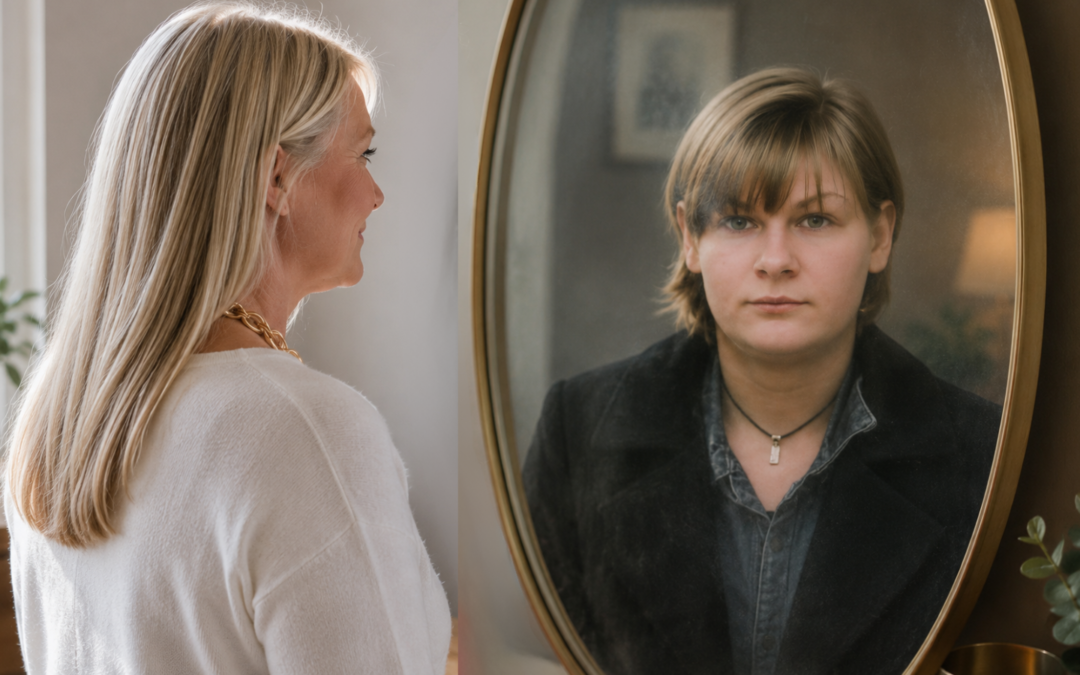
Have you ever found yourself doing something and wondered afterwards: “Why on earth did I do that?”
- Perhaps you always say, “I don’t mind,” even when you do.
- Perhaps you apologise before sharing an idea.
- Perhaps you remember the one criticism and completely forget the ten compliments.
- Perhaps you wait until you feel ready before applying for the promotion.
At first glance, these all look like completely different behaviours, but they’re not. More often than not, they’re different expressions of the same hidden pattern.
The Problem Isn’t The Behaviour
One of the biggest misconceptions about confidence is that people assume confidence is the behaviour itself. They think confidence is:
- Speaking up.
- Asking for the promotion.
- Saying no.
- Sharing an opinion.
- Wearing the right clothes.
- Putting yourself forward.
But those are simply behaviours. The interesting question isn’t what we do, it’s why we do it.
- Why does one person naturally speak up while another hesitates?
- Why does one person confidently ask for the promotion while another convinces themselves they’re “not quite ready”?
- Why does one capable professional walk into a meeting and command attention while another, equally capable person, quietly blends into the background?
That’s where the real answer lies.
Every Behaviour Makes Sense
Imagine somebody who always says: “I don’t mind, whatever you fancy.”
It might look as though they don’t have an opinion, but the reality is they may care deeply. They’ve simply learned that keeping everyone else happy feels safer than expressing what they really want.
Or someone who begins every contribution in a meeting with: “Sorry… can I just…”
It sounds polite, considerate and it sounds respectful, but without realising it, they’ve already reduced the weight of what they’re about to say. The people listening don’t hear their intention, they hear uncertainty.
Then there is the capable employee who volunteers to organise the meeting, take the minutes, arrange the lunch or book the room. They’re being helpful, reliable and supportive, yet everyone around them slowly begins to see them as the person who provides support rather than the person who provides direction.
None of these people wake up in the morning and consciously decide to hold themselves back.
Their behaviour makes perfect sense, but the trouble is, it only makes sense to them. Everybody else sees something completely different.
- They don’t see: “She’s trying not to upset anyone.”
They see: “She never has an opinion.”
- They don’t see: “She’s trying to sound polite.”
They see: “She doesn’t sound very confident.”
- They don’t see: “She’s trying to be helpful.”
They see: “She’s not really leadership material.”
- They don’t see: “She’s waiting until she’s ready.”
They see: “Someone else who’s more ambitious.”
And that’s where so many capable people become frustrated: they judge themselves by their intentions while other people judge them by the signals they receive.
The Gap Nobody Talks About
This is the gap I see time and time again.
- Someone feels nervous, other people think they’re intimidating.
- Someone feels humble, other people assume they lack confidence.
- Someone feels cautious, other people assume they lack ambition.
- Someone feels considerate, other people conclude they don’t have strong opinions.
The behaviour makes complete sense when you know the story behind it. The problem is nobody else knows the story.
This Was Me
The reason I care so much about this isn’t because I read it in a book, it’s because I lived it. When I was in my twenties, I was the woman who said, “I don’t mind.”
- I apologised before speaking.
- I dressed for the job I had, not the one I wanted.
- I remembered every criticism and forgot every compliment.
- I desperately wanted people to see my potential, yet somehow I kept behaving in ways that unintentionally hid it.
At the time, I thought the answer was somewhere outside of me. Perhaps I needed a better manager, perhaps I hadn’t found the right organisation or perhaps one day someone would finally recognise what I was capable of.
But after years of frustration, disappointment and wondering why the things I wanted never quite happened, one uncomfortable question kept coming back to me: what if I was unconsciously doing things that were making it harder for other people to see the person I already knew I was?
That question changed everything. Not because I suddenly blamed myself – quite the opposite – for the first time, I realised I had influence. If these behaviours had been learned, perhaps they could also be changed.
Looking back now, that’s exactly what was happening: people weren’t responding to my intentions, they were responding to the signals I was unconsciously sending.
Once I understood that, so much of my working life suddenly made sense, but understanding the pattern was only the beginning. The next challenge was changing it.
I searched everywhere: psychology, neuroscience, learning, coaching, NLP, CBT, communication, books, retreats, courses and mentors. You name it, I tried it!
Some ideas were fascinating but made very little practical difference while others worked brilliantly. Slowly, I began piecing together the approaches that genuinely changed behaviour, not just consciously, but unconsciously too.
Over the last twenty years, I’ve tested, refined and organised those ideas through my work designing learning and development programmes, coaching professionals and delivering training for organisations across the UK and internationally.
The Confidence Breakthrough™ Live is the programme I wish someone had given me in my twenties.
Not another motivational talk, not another collection of confidence tips, but a structured, step-by-step roadmap that brings together everything I’ve learned about changing the hidden patterns that quietly shape how we think, feel and behave.
Because I know what it’s like to spend years trying harder and I also know what becomes possible when you finally change the pattern instead.
Hidden Patterns Are Not Personality
Perhaps the most encouraging thing I’ve learned is this: these behaviours aren’t personality traits, they’re learned patterns.
Most of us developed them years ago. At the time, they probably served a purpose (helped us avoid criticism, fit in or stay safe), but the problem is that many of those same patterns quietly follow us into adulthood, long after we need them.
What once protected us can begin limiting us, but the good news is that anything that has been learned can also be relearned.
You Don’t Need To Become Someone Else
Whenever people hear the word confidence, they often assume they need to become louder, more outgoing, more assertive and more extroverted. I don’t think that at all.
Confidence isn’t about pretending to be somebody different, it’s about making sure the signals you send genuinely reflect the capable person you already are.
Because people don’t respond to our intentions, they respond to the signals they receive.
Once you understand the hidden patterns shaping those signals, you can begin to change them. Not by acting, not by performing, but by understanding why they were there in the first place.
And once you discover the pattern, you can finally choose a different one.
Ready To Change The Pattern?
If you recognised yourself in any of the examples above, you’re certainly not alone. They’re some of the most common hidden patterns I see in capable professionals, and they’re all completely changeable.
That’s exactly what we’ll be doing inside The Confidence Breakthrough™ Live, which begins on 22 September 2026.
Over six live online sessions, you’ll uncover the hidden patterns that have quietly shaped your confidence, your behaviour and your career.
More importantly, you’ll learn how to change them.
Together, we’ll replace patterns that no longer serve you with ones that allow your capability to be seen as clearly by others as you already know it exists within yourself.
Because you don’t need to become someone else, you simply need your outward behaviour to reflect the capable person you’ve been all along.
Because confidence isn’t about becoming somebody new, it’s about finally allowing the real you to be seen.
Simply enter your details below and I’ll send you the programme dates, pricing and everything you need to know.