
If you’re honest, control probably doesn’t feel like a problem, it feels like:
- being prepared
- thinking things through
- double-checking your work
- staying on top of things
- protecting yourself from mistakes
From the outside, this looks like competence, but from the inside, it can often feel like tension and that difference matters.
When control feels like safety
When work feels uncertain – a new role, higher expectations, unspoken rules, shifting priorities – your nervous system looks for something solid – not because you don’t trust yourself – but because uncertainty is interpreted as risk.
The nervous system is wired to prioritise safety before growth so when clarity, predictability, or reassurance are missing, it compensates. And this is where control steps in.
Control becomes an anchor, a way to reduce exposure and a way to feel steady when certainty isn’t available. So you might find yourself:
- over-preparing before speaking
- replaying conversations afterwards
- holding back ideas until they’re “ready”
- working harder than necessary to avoid mistakes
- holding yourself to standards you’d never expect of others
This isn’t weakness, it’s protection.
Why capable people tighten rather than fall apart
One of the biggest misunderstandings about confidence is the idea that when people feel unsure, they disengage. In reality, capable people usually do the opposite: they tighten. So they become more careful, more conscientious and more controlled.
Especially in early career – or during periods of stretch – people don’t want to be seen struggling so instead of pulling back, they grip harder. This isn’t to impress, it’s to stay safe.
Control is often a sign of commitment, not incompetence, but it comes at a cost.
The link between comparison and control
If you read last week’s blog on comparison, this next part may feel familiar. Comparison doesn’t just affect how you feel about yourself, it changes how safe you feel in your environment.
When you’re quietly measuring yourself against others – their confidence, their pace, their polish – your nervous system draws a simple conclusion: I need to be careful.
That’s when control often increases:
- “If I can just get this right…”
- “If I don’t make mistakes…”
- “If I don’t show uncertainty…”
Control creeps in not as ambition, and not as excellence, but as a strategy to avoid exposure.
Where perfectionism fits in
Perfectionism is one of the most socially acceptable forms of control at work because it sounds reasonable, even admirable:
- “I just have high standards.”
- “I want to do a good job.”
- “I don’t like rushing things.”
And often, perfectionism is even rewarded. But psychologically, perfectionism is rarely about quality because underneath, it’s saying: I don’t want to be seen getting this wrong.
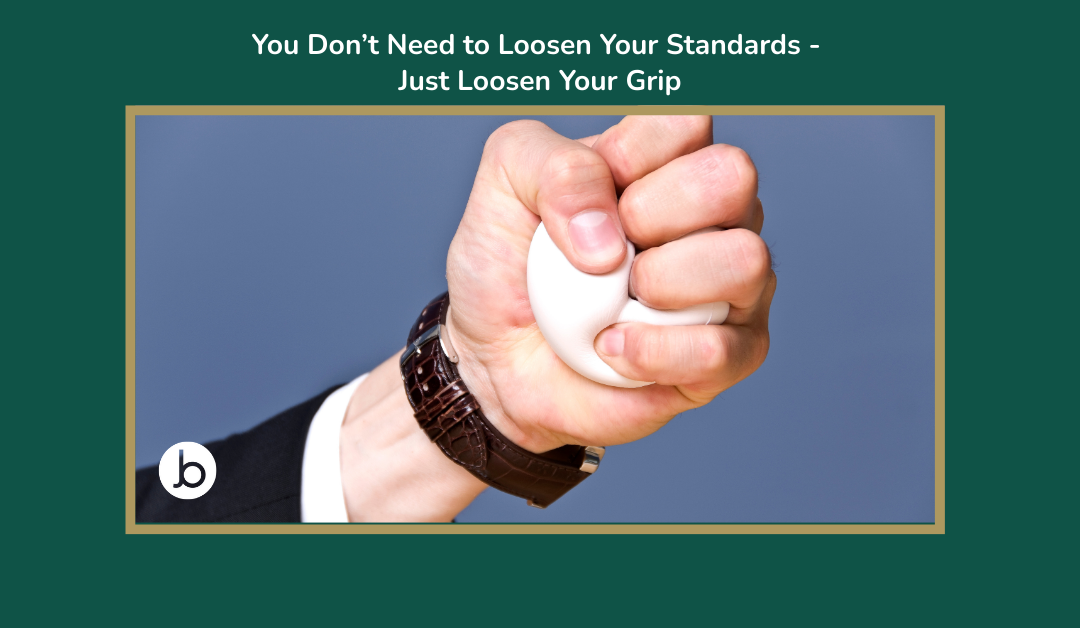
Perfectionism isn’t about doing things well, it’s about not wanting to be seen doing them imperfectly. The standards don’t change, but the grip tightens.
Why control costs more than it gives
At first, control can feel productive, it can create short-term relief and it can even deliver good results, but over time, it quietly starts to cost you. Control-based coping tends to:
- drain mental and emotional energy
- slow decision-making
- increase self-doubt
- keep confidence conditional (“I’ll feel okay once this is finished / approved / perfect”)
You don’t feel more capable, you feel more careful and living in a constant state of carefulness is exhausting.
What loosening your grip actually means
Loosening your grip isn’t about caring less and it’s definitely not about lowering your standards; it’s about changing where safety comes from. Loosening your grip looks like:
- letting effort exist without constant self-monitoring
- contributing before you’re completely sure
- allowing yourself to be seen mid-process
- trusting that growth doesn’t require perfect execution
Confidence doesn’t come from control, it comes from feeling safe enough to move without it.
A gentler way forward
If you recognise yourself in this, don’t try to “fix” it because control isn’t a flaw – it’s information. It’s a sign that some part of you is trying to protect you.
This is one of the core patterns I explore more deeply in The Confidence Breakthrough and in the wider Confidence Breakthrough programme where we look at how behaviours like control form, what they’re protecting, and how to loosen them without losing your standards or your sense of competence.
If you’re not ready to explore that yet, a much gentler place to start is awareness. I’ve created a short 2-minute Free Confidence Block Quiz to help you identify what’s most likely driving your confidence patterns at work – without judgement, pressure, or fixing.
👉 Take the 2-minute Free Confidence Block Quiz and find out where your biggest blockers are.