
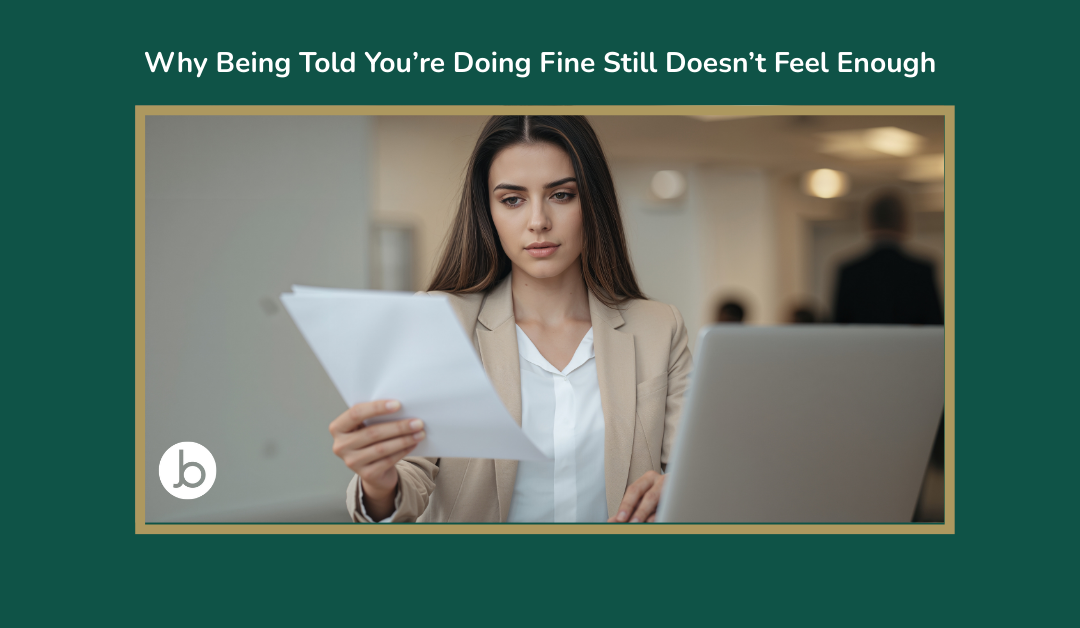
In the early stages of your career, confidence is often talked about as something you either have or don’t have. But in reality, confidence is shaped quietly – through the environments you’re in, the expectations you’re navigating, and how safe it feels to trust your own judgement at work.
For many people, confidence doesn’t disappear, it just moves outside of them.
I didn’t realise this at the time, but when I was in my early career, I slowly started outsourcing my confidence. I cared about doing a good job. I wanted to get things right. I didn’t want to make avoidable mistakes or look foolish in front of people who seemed to know far more than I did.
So I checked.
I’d run decisions past others “just in case”, I’d wait for feedback before trusting my judgement and if someone didn’t reply to a message, I’d quietly assume I’d done something wrong.
At the time, this didn’t feel like insecurity. It felt sensible. Professional, even. What I didn’t realise was that I was slowly outsourcing my confidence.
When reassurance becomes emotional relief
If you’re someone who often seeks reassurance, you’ll recognise the feeling.
You ask the question, you wait for the response and when it comes – “Yes, that’s fine” – your body relaxes. The tension drops, your shoulders soften and you can breathe again.
Reassurance works. But only briefly because that sense of relief didn’t come from trusting yourself, it came from someone else confirming you were okay. And as soon as the next moment of uncertainty appears, your nervous system goes looking for it again.
Why this isn’t a confidence flaw
If you often need reassurance, there’s nothing wrong with you, it doesn’t mean you’re weak, needy, or incapable. In fact, reassurance-seeking often shows up in people who care deeply, think carefully, and want to do well.
What’s usually happening underneath is something quieter: your nervous system has learned that safety comes from approval. That learning often happens when:
- you’re still working out unspoken rules
- you’re surrounded by confident or experienced voices
- feedback feels inconsistent or delayed
- mistakes feel socially risky
In those environments, your system adapts. It learns that acting alone feels unsafe, and that relief comes when someone else confirms you’re okay.
So the question your body is asking isn’t, “Am I capable?”
It’s, “Am I safe to trust myself here?”
How reassurance quietly limits confidence
The tricky thing about reassurance is that it feels helpful, it calms anxiety, it reduces uncertainty and it gives you a momentary sense of steadiness. But over time, it can start to erode confidence rather than build it.
You hesitate longer before deciding, you doubt yourself even when you know the answer and you feel unsettled when feedback is absent – even if nothing is wrong.
Confidence becomes conditional. Something you receive, rather than something you carry. And that’s exhausting.
Why reassurance never lasts
The problem with reassurance is that it doesn’t teach your nervous system that you are safe to trust, it teaches it that safety comes from outside of you.
So each time uncertainty appears, the urge to check returns, the relief wears off faster and the cycle repeats.
It’s not that reassurance is bad. It’s that it was never meant to do the job of confidence.
What actually helps confidence grow
Confidence doesn’t grow by cutting yourself off from others or forcing yourself to “be more confident”. And it doesn’t grow by criticising yourself for needing reassurance.
It grows when your nervous system starts to experience something different. That might look like:
- noticing the urge to check without immediately acting on it
- deciding first, then seeking input – not the other way around
- tolerating the discomfort of not knowing straight away
- letting yourself learn in motion, rather than waiting to feel ready
Confidence builds when your system learns that uncertainty doesn’t automatically mean danger. That learning takes awareness, not pressure.
A small but powerful shift
One of the most helpful shifts is this:
Instead of asking, “Is this okay?”
Try asking yourself, “What do I think – and why?”
You can still check and you can still ask for input, but you’re no longer handing your confidence over before you’ve even formed an opinion.
That’s how confidence starts to move back inside.
If this feels familiar
If you recognise yourself here, there’s nothing you need to fix. Reassurance-seeking is not a personality flaw. It’s a protective strategy your system learned for a reason. But it doesn’t have to be the way you keep yourself safe forever.
A gentle next step
If you’d like to understand your own confidence patterns more clearly – including where reassurance, comparison, and control might be showing up – I explore this in depth through The Confidence Breakthrough Programme and The Confidence Breakthrough book.
If that feels like too much right now, start small.
👉 Take the Free Confidence Block Quiz to identify what’s really sitting underneath your confidence at work – and where to focus first.